In our "how can we help you?" thread, a reader writes:
On the topic of "tippy top" schools, how much can good publications offset coming from a lower ranked school on the job market? I'm set to defend in the fall and my department isn't particularly notable. I have however been fortunate enough to get two publications in top tier journals. Should I keep aiming to publish at high ranked journals or I am better off submitting to mid-level journals where I may be more likely to accumulate publications?
I'd be very curious to hear what readers think, particularly those who have been involved in hiring. For my part, I have to sadly confess–as I have before–that I am skeptical that publishing in the highest ranked journals is a very good job-market strategy for candidates coming out of lower-ranked programs. Allow me to explain why.
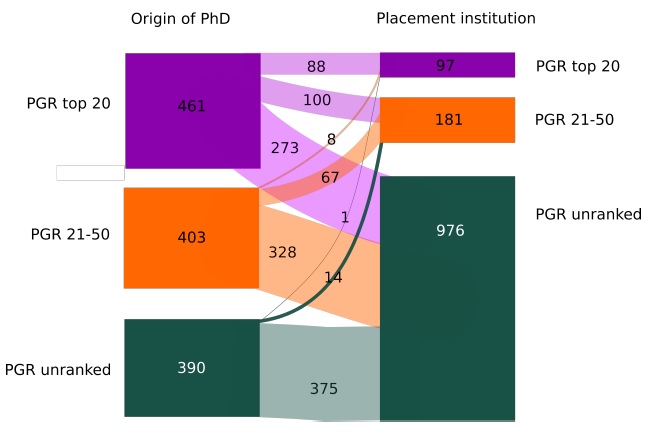
First, there is hard empirical data that it is extremely difficult (if not impossible) to 'publish one's way up' to be competitive with candidates coming out of prestigious programs. One 2015 study of 19,000 faculty in three different disciplines found a “steeply hierarchical structure that reflects profound social inequality”, such that "just a quarter of all universities account for 71 to 86 percent of all tenure-track faculty in the U.S. and Canada in these three fields" and, "Just 18 elite universities produce half of all computer science professors, 16 schools produce half of all business professors, and eight schools account for half of all history professors…". Similar, as the following image illustrates, our own Helen De Cruz's 2018 study on prestige bias found that PhDs from lower-ranked departments rarely secure employment in prestigious research departments:
Second, there are anecdata. Over a number of years starting in about 2006 (before I first went on the market), I spent a lot of time on job-market message boards–including at the once-popular but now defunct Philosophy Smoker. Each year in reporting threads at the Smoker and elsewhere (including here), the same sad trend emerged: person after person saying, "I have X number of top-5 journal publications but no interviews!". Meanwhile, I knew plenty of people who had many publications in less-prestigious journals who got a lot of interviews, and ultimately, permanent job offers–and the anecdotal data I culled from PhilJobs in 2012 supported this: multiple publications in lower-ranked journals appears to help and not hurt candidates. Further, two 2019 experiments published in the Journal of Experimental Psychology: Applied found the same thing in psychology. Contrary to what people often say ("Don't publish in bad journals. Search committees will hold it against you!), the experimenters found that publications in low-impact journals help job-candidates. More specifically, the experimenters found the following:
Two experiments revealed that an applicant was rated as stronger when several weak publications were added to several strong ones and was rated as weaker when the weak publications were removed. A third experiment showed that the additional weak publications were not merely viewed as a signal of additional strong publications in the future; instead, the weak publications themselves appear to be valued. In a fourth and final experiment, we found that adding a greater number of weak publications also strengthened the applicant, but not more so than adding just a few. The study further suggests that the weak publications may signal ability, as applicants with added weak publications were rated as both more hardworking and more likely to generate innovative research ideas. Advice for tenure-track psychology applicants: Do not hesitate to publish in even the weakest journals, as long as it does not keep you from publishing in strong journals. Implications of the market rewarding publications in low-impact journals are discussed.
Long story short: publishing in some top-ranked journals is great. However, the balance of evidence suggests that continuing to shoot primarily for top-ranked journals may not be the best job-market strategy, especially for candidates coming out of lower-ranked or unranked programs like the original commenter. Is this sad? Is it unfair? I would be the first to answer "yes" to both questions. But this is the academic environment we find ourselves in, and it may well be that a lot of candidates from lower-ranked schools shoot themselves in the foot by adopting a suboptimal job-market strategy.
To be clear, none of this is to say that it is impossible for candidates from lower-ranked programs to get great jobs by publishing in top-ranked journals. I've seen it happen from time to time on the Phil Appointments page–and Helen's study suggests that it is possible too. The point is simply that job-candidates coming from lower-ranked or unranked programs should know what they are up against, and what the empirical facts suggest. I also suggested some alternative job-market strategies here, for those who are interested.
But these are just my thoughts. What are yours?
Leave a Reply