I recently announced on Facebook that I left my NTT position for a non-academic one and offered to talk more about it. Marcus then asked if I might write something up for PC, which is something I am very happy to do!
It is very easy to get a non-academic job. All that you have to do is contact a friend who can get you hired and ask that friend to get you hired. Then, you interview with some people, possibly as a formality, and eventually, you get hired.
***
But the process of getting to the point where one can call upon such support can be frustrating and time-consuming and feel at times demeaning and hopeless. I started looking casually at non-academic positions a few years ago and much more seriously over the past few months. Looking back at various relevant conversations, interviews, and activities over the past couple of years, and the strategy that I cobbled together from others and applied in fits and starts, I now think that I could have successfully transitioned out of academia into an interesting and rewarding position in six months or less. The same should apply to you.
What I will do from here is state some things that I’ve learned and provide some personal commentary on each. These will be tidbits, and I hope to revisit this topic in more detail later. Although it makes me a little uncomfortable to offer advice, I am going to write this largely as advice, because that’s what I needed during my job search. I won’t spend any time on how hard it is in academia, or why a person would want to leave. I’ll write this for the person who already wants to leave. I’ll assume that’s common ground. I previously told the story of my academic search struggles here Sweat Equity on the Philosophy Job Market – The Philosophers' Cocoon (typepad.com).
Before I start, I do think it’s fair to say that mine is a success story. In the past month, I have been a candidate for a few positions in four distinct fields and had serious offers for further discussion about still other positions once I accepted the first offer. (Has that happened to you in philosophy? You tell someone, “I published yet another epistemology paper!” and they say, “Oh, really? We’re looking for epistemologists right now!”) The position I accepted is partly commission-based, so if I manage to make a non-zero commission, I will immediately earn more money than I did in my philosophy job, and potentially 50% more than in my philosophy job—at that’s all just the first year, while my philosophy job would pay the same until I die. On a personal note, I love the outdoors, and I am excited to finally be able to go camping in September again, which is impossible as an academic; I’ll be working remotely, so I can go anywhere I want to go and see my family regularly throughout the day; the work is interesting to me; and the career growth potential is astounding, especially in comparison to continuing in academia, where in your entire life you either get one promotion (two depending on how you count) or none (if you’re NTT, like me).
1. Having a Philosophy Ph.D. Is a Liability, Not an Asset
In one final interview for an analyst position at very well-known logistics company, the hiring manager I’d been talking with brought in someone who once held the same role and went on to climb the company ladder. After I had the opportunity to show in specific, clear, vivid detail how work I had done in my academic job, in epistemology, and otherwise applied specifically to the job requirements, she said, “You know, when I saw your resume, I said to [hiring manager], ‘Philosophy Ph.D.? Are you serious’ But when you explain it it makes sense.”
A senior HR director at a global marketing company said she would not have given my resume more than a second’s glance after seeing my education unless she’d already known more about me. I have had other interviews with similarly negative remarks about my education and academic work history. How many times was my application thrown out because of my education, which I always thought was a significant accomplishment?
When I say the degree is a liability, not an asset, I mean this: the *mere fact* that you have a philosophy Ph.D. counts against you, not for you. It is a reason to throw your resume out, a reason to hire the other candidate. The way to manage this is to show how, in very specific detail, with specific examples that appeal to the relevant audience and position, that YOU HAVE ALREADY DONE THE WORK THAT YOU’VE APPLIED TO DO. The reason you need to do this is that on a resume you can’t hide what you’ve done with the past 5-8 years of your life. So, you need to make it relevant to your new pursuit. And if you can do that, and you can talk specifically, clearly, vividly, about how the work you have done perfectly fits with what they are looking for, then you will sound like someone who can do the job who in virtue of the Ph.D. is also a serious thinker, and that’s a person with a lot of potential for growth.
2. YOU HAVE ALREADY DONE THE WORK THAT YOU’VE APPLIED TO DO
Your resume, and the way you talk about your education, experiences, and sometimes even hobbies, should be tailored to the job you’ve applied to do. It’s not that you can do the job. It’s that you have already been doing the job for years, you just haven’t held the title. You don’t need someone to give you a chance: you are making a lateral move. Repeat until confident belief is achieved.
Looking back, the interviews that I think I botched in recent years were ones where I felt like I was asking for the favor of getting me out of academia. That’s a mistake. You have to constantly remember that the other person is doing something risky in hiring anyone at all, as a bad hire can cost the company a lot. So, you have to demonstrate that you have already been doing the job, and make the case that hiring you is a bet with low risk and a high probability of reward.
Say you’re applying for this job, which I pulled up on LinkedIn just now for the purpose of this blog: Medifast – Careers – Inventory Control Analyst in Baltimore, Maryland | Careers at Baltimore – US Headquarters (icims.com). Do click on it, as I’ll refer to it. Here’s a snip of the description:
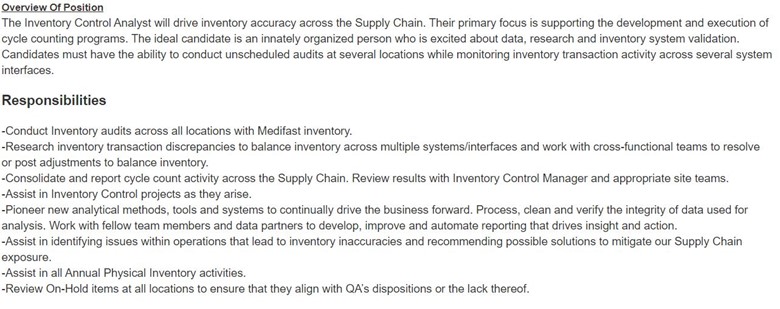
Would anyone hire you to do this job? Here is the list of qualifications:
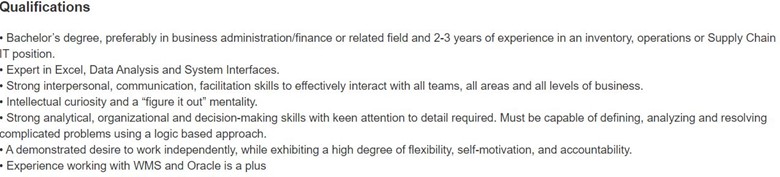
The third bullet point is this:
- Strong interpersonal, communication, facilitation skills to effectively interact with all teams, all areas and all levels of business.
You’re a philosophy teacher, so of course you have “strong communication and interpersonal skills”. You can get freshmen to read Theaetetus! You can do this job!
But you have to find the right way to communicate that. Switching seats and taking the recruiter’s position, which of the following two resume lines sounds like it is from the person who satisfies that Qualification?
- Taught introductory philosophy courses to a diverse student body
- Captured attention and persuaded clients (students, administrators) with dynamic, client-focused presentations
You can see that it is definitely person B. Those examples were taken from my old resume (A) and my current one (B). Both describe the same type of work experience: talking about ideas with students (A) or students and administrators (B). What makes B far better as a descriptor of what the philosophy teacher does is that it speaks to the activity and skills involved without unduly limiting the skill to something that almost no one understands. That makes (B) sound applicable to the Qualification in a way that (A) does not.
To make your resume relevant, look at the things you do and describe them in a way that the person reading your resume can understand, so that they can see that you are fit for the job. Tip: (literally) copy words from the ad into your resume wherever you can point to a specific responsibility that you have had. If you’ve written a conference paper, been published, or written a dissertation, then you can absolutely use the following line in your resume. Check the Qualifications again, and note the overlap between the following and the language in Qualification 5:
- Effectively analyzed and resolved problems using a systematic, logic-based approach
Why wouldn’t you say that if you’ve gotten positive feedback on your philosophical work? In interviews, do the same: be prepared to relate exactly how what you have done matches the responsibilities of the job you’ve applied to do. Below, I’ll discuss what to do if some of the essential qualifications describe things that you truly have not done.
3. Networking
This summer, there were 4 positions for which I was a finalist and/or received an offer. I had some type—even very minimal—of prior relationship with someone at the company for 3 of them. I probably applied to 40 jobs in total. So, 10% of the jobs I applied for involved some prior relationship, but a huge 75% of the jobs that were interested in me involved some prior relationship.
Not all networking is cold-contacting. Ask for connections through your graduate school friends, neighbors, kids’ friends’ parents, your dissertation advisor, your mom, your department’s administrative assistant, the college librarian—anyone you’re friendly with. This part should not be challenging if you are a friendly person. People will want to help you, just as you like to help others.
Sometimes you won’t have a connection with someone you’d like to talk with. There is nothing wrong with contacting someone and asking if they would be willing to share their work experience while you try to figure out if their line of work is a good fit for you. Wouldn’t you be excited to get an email that from someone that says they think your line of work sounds interesting, and they’d like to hear you talk about your experience and skills to see if maybe they could be like you? In my recent search, I have conversed for hours by phone or Zoom with at least 12 people about various jobs and career paths that I’m interested in.
I recommend Austin Belchak’s approach as outlined on his website and newsletter. I have found his advice very beneficial in my search. His strategy is basically this: develop your skills and experience so that you can reasonably say that you can fulfill the responsibilities of a particular job, contact people at the target company to establish relationships, learn what issues the company/department is facing, then put together a demonstration that shows you can fill that need.
I used this strategy myself for the logistics analyst position. I had to look up lots of the words in the advertisement. But I reached out to the recruiter beforehand with a reasonable question—not “please hire me!” or “give me a chance!”, but a sincere acknowledgement of her expertise in selecting candidates to screen with a request to see if I could be considered with my atypical background, which led to a very brief but friendly message exchange through LinkedIn. I was invited for an interview a week later, and after that interview, I passed along a PowerPoint based on a committee project that I did which showcased my analytical abilities. In the second-round interview, one of the interviewers acknowledged having reviewed the PowerPoint, and said, “You definitely think like an analyst.” (Would I have gotten that interview without putting in the effort to create that presentation demonstrating my skills?) Put differently, I have the skills they’re looking for even though I didn’t have a single day’s work in that field or with those responsibilities.
I also highly recommend the most recent edition of “What Color Is Your Parachute?” It’s a standard career-change testimonial/workbook/guidebook. Some of the exercises struck me as hokey and may strike you the same way. Do them anyway. The takeaways can be insightful. I realized that what I want out of a job can be summarized very briefly: (1) freedom, (2) the opportunity to use my skills in critical thinking and analysis and research, and (3) opportunity for career growth. (My NTT job offered a lot of 1, a little of 2, and none of 3. My new job offers a decent amount of 1, a decent amount of 2, and a tremendous amount of 3. That’ll do.)
Last thing: you absolutely must be on LinkedIn and put effort into creating your profile. Choose a picture that makes you look approachable, but also serious. You will appear in searches based on words that you enter in your profile, you can showcase achievements, and it’s probably the best place to look for positions right now. I completed the Google Data Analytics Professional Certificate on Coursera this summer, which offers a virtual credential that is displayed on my LinkedIn profile. During a final-round interview for the position I was offered, one of the interviewers mentioned looking at my LinkedIn profile and seeing that credential and mentioned it as evidence that I am interested in the technology industry (which is the industry for that position). I had not even thought of making that argument.
4. Starting Over
This is related to the earlier advice: Your Philosophy Ph.D. is a Liability. You will probably need to take a position that sounds beneath you, in the sense that some of the responsibilities are or at least sound like they are ones that involve less responsibility than being an expert weighing in on course content, curriculum, departmental policies, etc. This is likely unavoidable. Although you likely have lots of experience that is relevant to career alternatives you are looking at, many positions seek candidates with a lot of experience in a specific field. Those are positions to grow into, and I recommend not even bothering to apply for them at first. In LinkedIn terms, you should focus on positions with “Entry-Level” and “Associate” in the title, as those are positions that require the fewest number of years in a specific field. (Side note: “Entry level” does not mean “entry-level worker,” as in “can walk out of the last day of undergraduate classes and get this job.” It means, “starting position for this career track.” Thus, people with lots of experience may be “entry-level”, and people fresh from college are not qualified for many “entry-level” positions.) If you are offered an Entry-Level or Associate position, think of it as a major opportunity for growth! I have yet to identify an “entry-level” position that pays less than what the average Assistant Professor of Philosophy seems to be making, which is low- to mid-50s.
In academia, we search for one job for life: get hired as Assistant Professor, get tenure, eventually get promoted to full Professor, all at the same place. That’s not how things work in the non-academic world. You need to find your next job, not your life job. You can leave it in a year. You could leave it in six months. The important thing is that you take a position that will help you build toward a goal.
5. Personal Growth
Always be meeting new people and learning new things. A strategy I settled on when I started in my academic position four years ago was to try to say “yes” to everything that I could that would improve my skills. Faculty are warned to avoid falling into the trap of saying “yes” to too much. That’s not what I mean: seek and say “yes” only to opportunities that improve your skills. My case for why I already had logistics analyst “work experience” rested significantly on a project that I led, and subsequent report that I wrote, assessing how well my college’s students performed in quantitative reasoning. I gathered faculty together to devise a definition of quantitative reasoning, led the development of a scoring rubric, recruited faculty members to score examples of student work, collected the results, and hunted for patterns. I was paid to do this for the college while a faculty member, but even if I had been paid nothing, it would have been worth it as the experience of doing that project was tremendously beneficial in my job search. The project probably took no longer than 20 active hours total, but I’ve been able to mention it in several interviews, and it’s been warmly received.
There are likely opportunities all around you that could have a similar benefit to your future. If you’re a graduate student, ask your department chair if there are any reports you could help put together, or ask faculty in other departments, or even administrators, if there are ways that you might offer some help—keeping in mind everything already said about leveraging your network and going into those discussions with some knowledge. If you’re a faculty member already, this should be more obvious: seek out committee responsibilities that stretch you.
Keep learning on the side, as well. There are lots of websites like Coursera that offer tons of courses, and sometimes credentials, from major universities and businesses, that you can use to learn about new industries and develop new, marketable skills. As I mentioned, I completed the Google Data Analytics Certificate through Coursera this summer. It took me about 15 days, averaging about 3-4 hours per day, though it could take you more or less time depending on your speed and other commitments. It did not make me a data wizard, but I can now meaningfully talk about the functionality of R versus Tableau for data visualization, and that might just be enough to become an entry-level analyst. Take a look around to see what you can learn in your spare time. It can help you find industries that interest you—or eliminate ones that don’t—and develop knowledge that you wouldn’t otherwise acquire as a graduate student or faculty member.
Knowledge like that can also help you see that, at least sometimes, a job that you thought you were unqualified for is within reach.
Let’s look again at the qualifications for that job above:
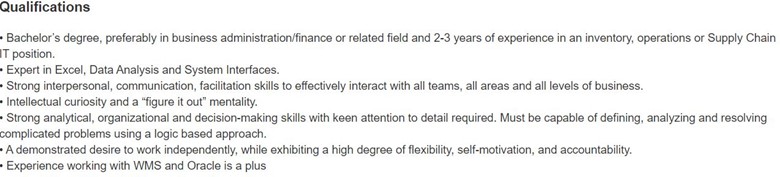
What if you’re interested in this job, but you aren’t an expert in Excel or WMS? I didn’t know what WMS meant until just now. I Googled it, and it means “Warehouse Management System”. (Insider terminology often means something very plain. Don’t be deterred by vocabulary.) On Coursera, several courses appear when “warehouse management” is typed into the search. Take one! The same goes for Excel. You can become far more proficient than the average Excel user in 4 hours, and I’m not exaggerating. One Sunday afternoon could change your career.
6. Getting Hired
Now we’re back to where we started. If you build relationships, people will know you, like you, and want you to be hired. If you build skills, your contacts will not be taking a risk when they sincerely tell someone at their own company, “You should hire so-and-so.” From there, and really only from there, it’s a matter of interviewing well, persistence, and a little luck.
Leave a Reply to David LuCancel reply