In my past two entries in this series–as well as in other past discussions of peer-review–I have tended to focus on how editorial practices and reviewer behavior might be improved: to better ensure quicker and more reliable turnaround times, as well as better reviewer comments. However, it increasingly appears to me that this is to focus on only one part of the problem.
As David Velleman noted here–and others have noted as well (see below)–another central reason why peer-review has the problems is does is the behavior of authors. Journals are overrun with far too many submissions, many of which seem–to editors and reviewers–as though they should have never been submitted in the first place. This bogs down the entire system, making reviewers not only more difficult to find but also increasing their workload (as they have more papers to review). This in turn may be one significant cause of 'poor reviewer behavior', both in terms of long turnaround times and the quality of their reports. Indeed, there seems to be significant anecdotal evidence for this.
First, respondents to our poll on peer-review generally agreed with the idea that too many half-baked papers are sent out for review:
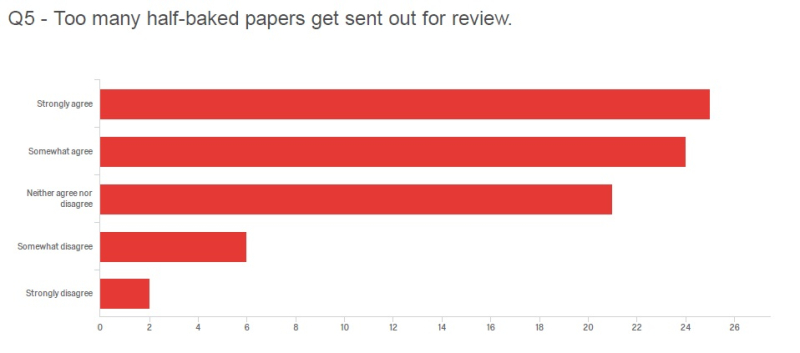
Second, there is anecdotal evidence that this affects how reviewers behave, and indeed, the quality and efficiency of the overall peer-review process. Over at this discussion at Leiter reports today, one commenter writes:
Michael Magoulias said…
A viewpoint from a publisher: This is ultimately a practical matter that reflects several factors: the number of submissions a journal gets, the size and frequency of its issues, and most importantly, the size of its editorial team. One major philosophy journal I worked with in the past had a single editor who was tasked with accepting roughly 25-30 papers a year for a quarterly journal. The typical volume of submissions in a given year was 500. It's simply not possible for one person to write substantive comments for that number of papers. The obvious solution is to expand the editorial team, but that is not always as easy as it sounds, especially, if one is dealing with a journal that is not affiliated with a society, and therefore lacking in a pool of specialist talent already committed to the organization sponsoring the publication.
Another commenter wrote:
I have received about 30 papers to referee in my life, out of which only about 15 were, at least in my view, worthy of submission (5 I recommended). The rest were just not ready for submission to any professional journal and should have been weeded out early on by the editors (though I understand that that's harder than it sounds). Providing comments on those would take forever – there were too many things wrong/lacking. Journals are not there to educate authors how to work in their field, even if publishing is a learning experience.
This broadly coheres with my own experience, both as an author and as a reviewer. As an author, I have to admit (with a genuine sense of regret and embarrassment) that there have been multiple occasions where I submitted papers that, in retrospect, were not ready to be sent out. On the other hand, as a reviewer I have also reviewed a fairly good number of similar papers: papers that, in my judgment, were nowhere near ready to be placed under review.
Now, of course, as someone who was once a desperate job-candidate (I spent seven years on the market), and then someone who had to publish to get tenure, there is an obvious sense in which I understand why this happens. Job-candidates and tenure-track faculty exist in "publish or perish" culture and incentive structure that makes it appear rational to them to submit as many papers as they possibly can–something which, en masse, leads to journals (and reviewers) being overwhelmed with too many unready submissions.
If we recognize that this is a significant problem, the question remains about what might be done about it. One possibility, which Velleman suggested, is to "philosophy journals should adopt a policy of refusing to publish work by graduate students." However, like many who responded to Velleman's suggestion, I worry that this is a proverbial case of a cure being worse than the disease. Publishing is, in a very real (albeit imperfect) sense, "the great equalizer": it enables graduate students from lower-ranked and unranked programs to demonstrate their philosophical abilities so that they can better compete on the market with people from more highly-ranked programs. Prohibiting graduate students from publishing would be unfair, giving graduate students at highly-ranked programs an even greater leg-up than they might already have.
Another, alternative possibility might be to disincentivize authors from submitting papers not fit for review. How might this be done? Here, I think, is an intriguing possibility. In my last two posts, I developed a proposal whereby reviewers might get an Overall Reviewer Score based on a number of factors: how quickly they respond to review requests, how many they accept, how quickly they get their reviews in, and the quality of their review reports (which might be evaluated by editor and author surveys). My proposal then was that this might incentivize better reviewer behavior if a person's Reviewer Score affected the kinds of reviewers they are paired with as authors (viz. good reviewers having their submitted papers evaluated by good reviewers, and bad reviewers having their papers reviewed by bad reviewers). Notice, however, that this is only one side of things. What if, in addition to this, authors were assigned an Overall Author Score based on reviewer and editor surveys of whether their papers were minimally fit to be placed under review? If a lower Author Score were used, along with one's Reviewer Score, to match one's newly submitted papers with reviewers, then being a bad author would be disincentivized as well. If authors want their papers to be reviewed quickly and by good reviewers (as most of us presumably do, including job-candidates and tenure-candidates), then in this system one would have to both be a good author and a good reviewer.
Might a system like this disincentivize authors from submitting too many plainly-unready papers for review–thus lessening the "Publication Emergency" Velleman discusses, easing up things for reviewers and editors, in turn helping them do a better, more efficient job? I'm not sure–but given how dissatisfied everyone seems to be with our current system (authors, editors, and reviewers alike), I think something like it may be worth considering!
Leave a Reply