This tweet was meant satirically, but taken in earnest by many people:
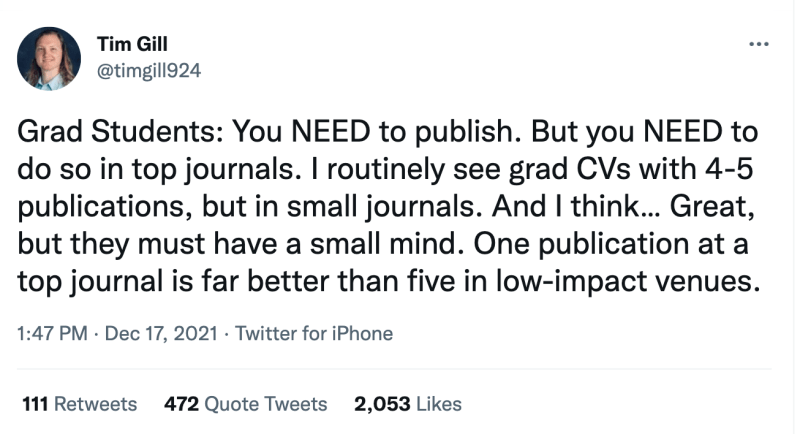
(I don't know how to do alt text here so I'll just also type out what it says: "Grad Students: You NEED to publish. But you NEED to do so in top journals. I routinely see grad CVs with 4-5 publications, but in small journals. And I think… Great, but they must have a small mind. One publication at a top journal is far better than five in low-impact venues.")
The tweet struck a nerve because it seems to be advice many grad students hear, or at least, gather from successes of others. It does seem that one paper in Philosophical Review is vastly better than a ream of papers in journals you never heard of, and even better than papers in respectable, but lower-ranked journals including specialist journals.
Here are my thoughts on the matter: there is no unified publication strategy that will work for all job candidates. You need a publication strategy tailored to your work, your level of risk aversion, and even your geographical location. Taking advice like this (meant non-satirically) can lead to a suboptimal job market strategy.
There is nothing wrong, of course, with publishing in Philosophical Review or a similarly prestigious journal as a graduate student. But advice along the lines of "just publish in Phil Review" is akin to advice young fiction writers get to "Just write a NYT bestseller" or job market candidates in all academic markets to "Just land a TT job at an R1".
You do not control publication, only submission.
For better or for worse, submitting can only be done at one journal at a time. Do not violate this rule even if a journal does not explicitly state a policy against it, as it is seen as extremely bad form (I have seen a couple of times as an editor this happen and it reflects very poorly on the candidate indeed).
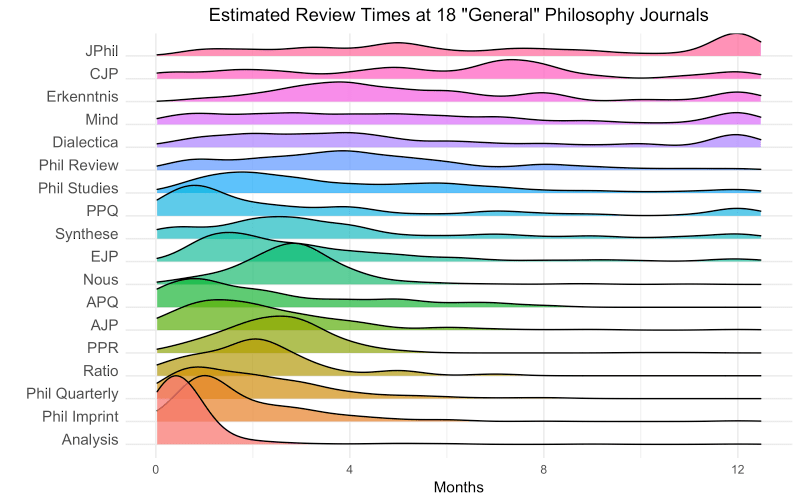
So, your paper is gone for several months, each time you submit. Acceptance rates of more prestigious journals are lower, because the number of submissions is much higher. This is not a strict one-to-one correlation but a good guideline. Each time you send out a paper you are putting it out for months at a time and the more prestigious a journal, the lower (on average) your chance of acceptance. Here below is a figure from Jonathan Weisberg that gives estimated review times.
In my editorial experience (I am not sure if there are official figures to back me up), graduate students, tenure track professors, and philosophers off the tenure track in postdocs or VAPs are much more frequent submitters of papers compared to tenured professors. This makes sense–they need more publication. Also, tenured professors have other venues available to them such as edited volumes and monographs. If you write a monograph, you have less time to also write papers for journals in addition to this.
I saw in the early stage of the pandemic a huge number of papers come in written by grad students, often of poor quality (no adequate grasp of literature etc). Again I am not sure if that is representative, but perhaps this was due to the collapse of the job market and grad students trying in a short span of time to improve their CVs. Though many of these papers were sent off to referees (in spite of some doubts, but if I am not triple-anonymous reviewing I tend to give grad students the benefit of the doubt), they were unsurprisingly rejected, often in firm terms. Submission, though it looks like a lottery, isn't a lottery. If you send something polished that you have gotten feedback on from others, there's a much higher chance it makes it through the review process. This underscores again the importance of sending only well-written and completed papers for review–if you think that you cannot reasonably improve anymore, that's the time to send it out.
When I referee for journals, I do take into account (somewhat) the prestige of the journal in that the paper needs to clear a higher bar for originality and maturity of thought for a more well-known and more prestigious journal (this also includes specialist journals) compared to less-known journals. I know not everyone does this, but at least some people do. As a referee, I do not know the identity of the author, so I can only go by the work itself. Some people say they can guess, but I can't. I am often surprised seeing a paper in print that I refereed–in many instances I thought "X might have written this?" but then it turns out the paper is written by a lesser-known grad student or other early career author.
Writing papers for publication is a craft that requires a high level of expertise, and this requires a long learning process. Much like a professional fiction writer's first novel (some exceptions notwithstanding) is not their best work, an academic will likely improve their craft over time. If you are not early career, what would you say your best work is up to now? I hazard to guess it's not your first paper based on a dissertation chapter.
In that respect, it can be hugely demotivating to send one's papers into the refereeing void to the most selective journals, only then to get harsh comments (or even no comments at all, in the frustrating "slow desk reject" I see at some journals). One needs significant mental resilience to send that paper out again. I've seen so many grad students use what I call to myself a "cascade" strategy, sending to the top journals one at a time, hoping it sticks, to then eventually give up or have no publication by the time they go on the market. The cascade strategy is hugely risky and demoralizing. It may pay off, but given the tiny odds, it very well might not.
I think it is important for the student to gauge whether the journal is a plausible fit for their work. Many philosophical specializations are underrepresented in "general" journals, whereas others (notably epistemology, metaethics) are overrepresented. It's possible, for instance, to get your paper in a less commonly taught philosophical tradition published in Philosophical Review. But it's difficult, seeing how few papers in LCT traditions are published there. So you go up against enormously tiny odds. Look where the work you are doing gets published, look at where the papers you are reading are published, and submit there.
Another issue to keep in mind is that not all hiring schools are interested in candidates with top journal publications. I know anecdotally people who have a huge list of publications in top generalist journals but no tenure track academic employment, in part because the rest of their profile (e.g., their grad school) is more in line with teaching-focused smaller schools. I have written earlier about how top research intensive schools hire mainly from each other, whereas candidates of lower-prestige graduating institutions rarely get jobs at such schools. However, they frequently get jobs at teaching focused colleges, including small liberal arts colleges and state schools that serve a large local student population.
One needs to keep these realities in mind when submitting papers for publication. It may be better for someone who focuses on jobs with high teaching loads (and there are many more of those than research-focused jobs) to attempt to publish one's work in a few lower-prestige but still decent journals rather than setting one's sights on top generalist journals.
Finally, there are differences across countries in the importance placed on journals. For instance, when I lived in Belgium and worked there, impact factor was a huge factor. It helped secure funding for universities. Now, many philosophical journals which are seen as lower-prestige have higher impact factors because they are cited more often by authors in the sciences. A Chinese grad student told me (I have no first-hand information) that the same is true in mainland China. A paper in Synthesis could, in this metric, have more impact than a paper in Philosophical Review. It is important to know the local culture of the country you are applying in (or countries, if you want to go more globally on the market) and strategize accordingly.
Leave a Reply to Assistant ProfessorCancel reply